
Education in the USA covers a large and diverse system that includes early childhood education, K–12 schools, community colleges, four-year colleges and universities, graduate programs, career and technical education, and adult learning. If you are specifically researching U.S. higher education as an international student, see our complete guide to studying in the USA. Unlike countries with one centralized education authority, the United States distributes many education responsibilities among states, school districts, institutions, and federal agencies.
That structure can make the U.S. education system difficult to understand, especially for students and families comparing schools, planning college, or considering study in America. This guide explains the main levels of education, types of schools, degrees, admissions, financial aid, accreditation, and the role of government in U.S. education.
How Does Education Work in the USA?
U.S. education is organized across several levels. Elementary and secondary education generally covers prekindergarten, kindergarten, and grades 1 through 12, although grade structures and terminology can vary by state and district. Postsecondary education begins after secondary school and includes academic, vocational, professional, and continuing education programs.
The National Center for Education Statistics (NCES), the federal statistical agency for U.S. education, collects and reports data covering education from early childhood through adult education. Its data and reports are useful for understanding how the system changes over time.
Main Levels of U.S. Education
| Level | What it generally includes | Typical outcome |
|---|---|---|
| Early childhood | Preschool and prekindergarten programs | Preparation for kindergarten and early learning |
| Elementary school | Early grades of K–12 education | Foundational academic skills |
| Middle school | Middle grades, depending on the local school system | Transition toward secondary education |
| High school | Secondary education through grade 12 | High school diploma or equivalent |
| Community college | Usually two-year undergraduate programs | Associate degree or certificate; some credits may transfer |
| College or university | Undergraduate study | Bachelor’s degree and other credentials |
| Graduate school | Advanced study after a bachelor’s degree | Master’s, doctoral, and other advanced degrees |
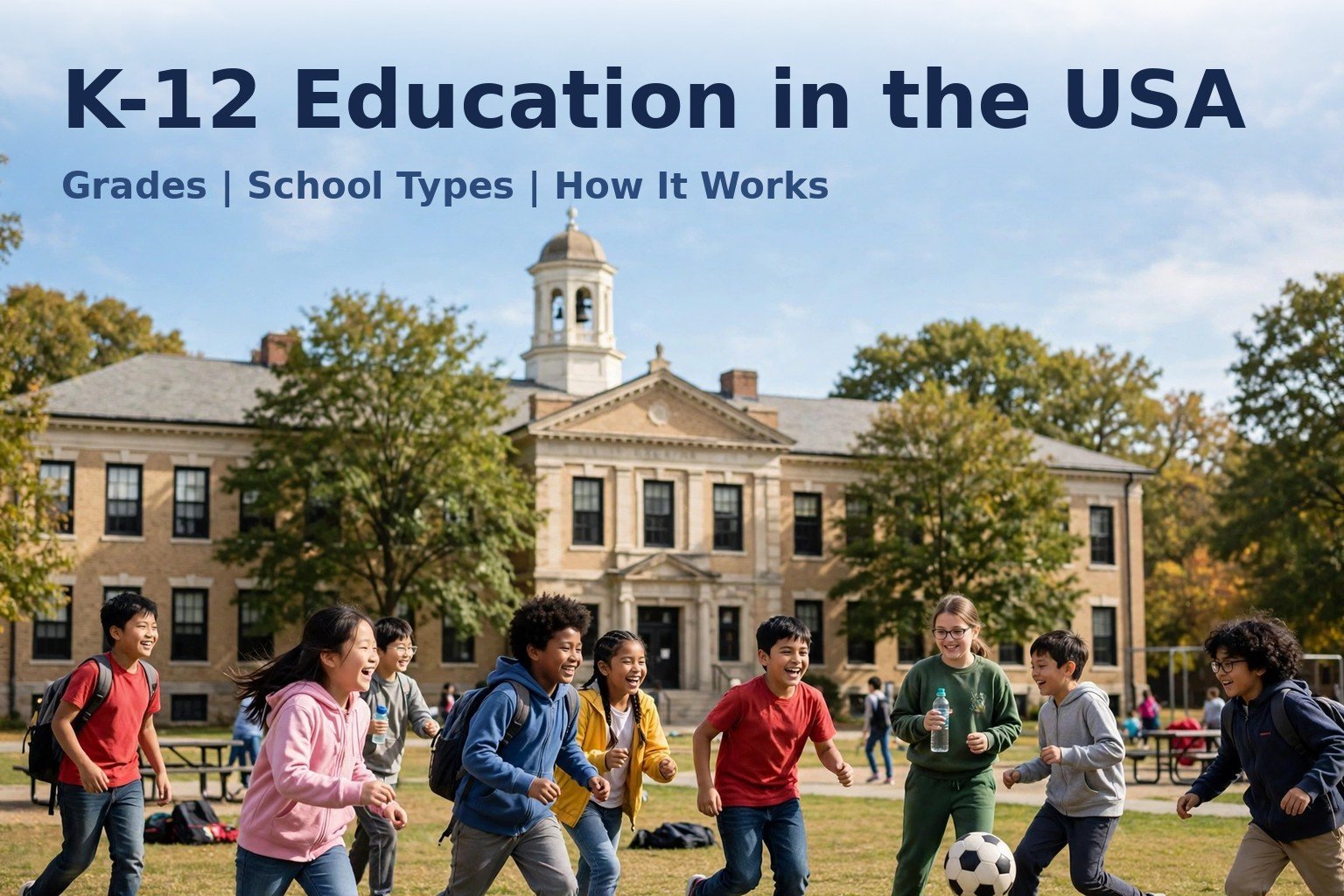
K–12 Education in the United States
K–12 refers broadly to kindergarten through grade 12. Public elementary and secondary education is primarily administered through states and local school districts rather than through a single national curriculum. State and local authorities determine many important details, including academic standards, graduation requirements, school policies, and curriculum frameworks.
School structures differ. A district may use elementary, middle, and high schools, while another may combine some grades into different configurations. Families should therefore check their state or local school district for exact requirements.
Public Schools
Public schools are operated by public education authorities and are generally tuition-free for eligible students attending the public system in their area. Public education includes traditional district schools and, where authorized, public charter schools.
Private Schools
Private schools are operated by private organizations rather than public school districts. They may have different admissions requirements, tuition structures, curricula, and policies. Families should evaluate the school’s authorization, accreditation where relevant, academic program, costs, and student services.
Charter Schools
Charter schools are public schools operating under a charter granted by an authorized body. Their organization and accountability arrangements vary by state. They are part of the public education landscape but can differ from traditional district schools in governance and program design.
Higher Education in the USA
After high school, students can choose from a wide range of postsecondary institutions and programs. NCES describes two-year institutions as institutions offering at least two years of college-level study, while four-year institutions offer programs leading principally toward a bachelor’s degree.
U.S. higher education includes community colleges, colleges, universities, career and technical institutions, and graduate and professional schools. The exact program structure, admissions process, tuition, academic calendar, and student services vary by institution.
Community Colleges
Community colleges commonly offer two-year associate degree programs and career or technical programs. Some students use community college as a pathway toward a bachelor’s degree by transferring eligible credits to a four-year institution. Transfer rules are not automatic, so students should confirm credit-transfer policies with both institutions before enrolling.
EducationUSA notes that community colleges can offer associate degrees and that some credits may transfer toward bachelor’s programs. Students should check each institution’s requirements and transfer agreements.
Four-Year Colleges and Universities
Four-year institutions generally offer bachelor’s degree programs and may also offer graduate degrees. Some are public institutions supported in part by state and other public funding, while private institutions have different ownership and funding structures.
There is no single model for a U.S. university. Institutions differ in size, academic programs, research activity, location, campus environment, admissions policies, cost, and student support.
Degrees and Credentials in the USA
One of the most important differences between U.S. education and other systems is the variety of credentials available.
- Certificate: A focused credential that may prepare students for a specific academic or occupational area.
- Associate degree: A common two-year undergraduate credential offered by community colleges and other institutions.
- Bachelor’s degree: An undergraduate degree normally requiring about four years of full-time study, although actual completion time varies.
- Master’s degree: A graduate credential providing advanced study or specialization after undergraduate education.
- Doctoral degree: An advanced degree involving substantial specialized study and, in many programs, original research.
- Professional degree: A degree designed for entry into a regulated or specialized profession, with requirements varying by field.
EducationUSA explains that undergraduate study can lead to associate or bachelor’s degrees, while graduate education can lead to master’s or doctoral degrees.
How College Admissions Work in the USA
College admissions are not governed by one national application standard. Each institution establishes its own requirements, deadlines, selection process, and policies.
Depending on the school and program, applicants may be asked for academic transcripts, application forms, essays or personal statements, recommendations, test scores where required or considered, portfolios for certain programs, and other supporting documents.
International students should also check the institution’s requirements for translated academic records, English-language proficiency, financial documentation, and immigration-related steps.
Why Requirements Vary
A selective research university may have a very different application process from a community college. Graduate programs can also have department-specific requirements. The safest approach is to use the official admissions website for every institution rather than assuming that one school’s requirements apply everywhere.
Tuition, Fees, and Other Education Costs
The cost of education in the United States varies substantially by institution, program, residency status, location, and level of study. For college students, the total budget can include tuition and required fees as well as housing, food, transportation, books, supplies, insurance, and personal expenses.
Public colleges and universities may charge different tuition rates to residents and nonresidents, depending on state rules and institutional policy. Private institutions generally set their own tuition and fee structures.
Because prices change, students should use the institution’s current cost-of-attendance information when planning a budget rather than relying on an old estimate.
Financial Aid and FAFSA
Financial aid can help eligible students pay for college, career school, or graduate education. Federal Student Aid states that the FAFSA is used to apply for federal financial aid and that states and schools may also use FAFSA information when determining eligibility for their own aid programs.
For the 2026–27 award year, the FAFSA is available to students and contributors. Depending on eligibility and program rules, aid can include grants, scholarships, work-study funds, and federal student loans.
Students should complete the FAFSA through the official Federal Student Aid website and check both federal and applicable state or school deadlines. The FAFSA is free to submit.
What Is Accreditation in U.S. Higher Education?
Accreditation is an important quality-related consideration when evaluating a U.S. college or university. In the United States, accreditation involves nongovernmental accrediting organizations, while the federal government has a role in recognizing accrediting agencies and administering certain federal programs.
The U.S. Department of Education explains that the United States does not have a single federal ministry that centrally controls postsecondary institutions. Colleges and universities can therefore differ considerably in their programs and operations.
Before enrolling, students should check the institution’s current accreditation status and understand whether the accreditation is appropriate for the degree or career they are pursuing. Some professions also have specialized programmatic accreditation or state licensing requirements.
Who Controls Education in the USA?
Education governance in the United States is shared across federal, state, and local levels, with important roles also played by independent educational institutions and organizations.
The U.S. Department of Education administers and coordinates many federal education programs, including federal student aid and certain elementary, secondary, and postsecondary programs. However, the Department does not run America’s schools or set a single national curriculum.
States and local education agencies have major responsibilities for K–12 education, including standards, requirements, school administration, and many policies. Colleges and universities also have substantial autonomy over academic programs and institutional operations.
Education for International Students
International students considering education in the USA need to research both academic and immigration requirements. EducationUSA recommends a process that includes researching study options, planning finances, completing applications, applying for a student visa when required, and preparing for departure.
Requirements differ by institution and program. Students should rely on the official international admissions office of the institution for application requirements and on official U.S. government sources for immigration information.
For students comparing U.S. colleges, useful questions include:
- Is the institution accredited by a recognized accrediting agency?
- Does the program match your academic and career goals?
- What are the current tuition, fees, and estimated living costs?
- What scholarships or financial aid are available to you?
- What are the admission and application deadlines?
- What academic credentials and English-language requirements apply?
- What support is available for international students?
- Are the credits or degree appropriate for your intended career or further study?
How to Choose an Education Path in the USA
There is no single path that fits every student. A practical approach is to start with the student’s current education level and long-term goal.
- Define the goal: Decide whether the priority is K–12 education, a career credential, an associate degree, a bachelor’s degree, graduate study, or another pathway.
- Compare institutions: Review programs, location, costs, admission requirements, accreditation, and student services.
- Check official requirements: Use the institution, state, and federal websites for current requirements.
- Build a realistic budget: Include tuition, fees, housing, transportation, food, books, and other expected costs.
- Research financial aid: Eligible students should review FAFSA and other federal, state, institutional, and private aid options.
- Plan deadlines: Keep a calendar for applications, financial aid, housing, and—when relevant—visa processes.
Education in the USA: Key Takeaways
The U.S. education system is decentralized and diverse. K–12 education is strongly shaped by state and local authorities, while higher education includes many types of public and private institutions. Students can choose from community colleges, four-year colleges, universities, graduate programs, career education, and other pathways. For another look at a major current trend, read our guide to how AI is changing education in the USA.
For students and families, the most important step is to verify details at the official source for the school, state, program, or federal aid program involved. Requirements, costs, deadlines, and policies can change, so current information should always take priority over older guides.
Frequently Asked Questions
What is the education system like in the USA?
The U.S. system includes early childhood education, K–12 schools, postsecondary education, graduate study, career and technical education, and adult learning. Many education decisions are made at the state and local levels.
What are the main levels of education in the USA?
The main levels are early childhood education, elementary school, middle school, high school, undergraduate education, and graduate or professional education. Postsecondary options also include community colleges and career-focused programs.
What is the difference between a college and a university?
The terms can overlap in the United States. In general, a college may offer undergraduate programs, while a university typically includes undergraduate programs and may also offer graduate and professional programs. Individual institutions use these terms differently.
How long is a bachelor’s degree in the USA?
A bachelor’s degree is commonly designed as about four years of full-time undergraduate study, but actual completion time varies by program, institution, course load, transfers, and a student’s circumstances.
What is FAFSA?
FAFSA stands for the Free Application for Federal Student Aid. It is the federal application used to determine eligibility for federal student aid, and FAFSA information may also be used by states and schools for their own aid programs.
Is accreditation important in the USA?
Yes. Accreditation is an important factor when evaluating a college or university. Students should check the institution’s current accreditation and determine whether it meets the requirements relevant to their program or intended profession.
Can international students study in the USA?
Yes. International students can apply to U.S. colleges and universities, but admission requirements, financial requirements, English-language requirements, and immigration steps vary by institution and program.
Does the U.S. Department of Education control all American schools?
No. The federal Department of Education administers and coordinates many federal education programs, but states and local education agencies have major responsibilities for K–12 education, and colleges and universities have substantial institutional autonomy.



4 thoughts on “Education in the USA: Complete Guide to the U.S. Education System”