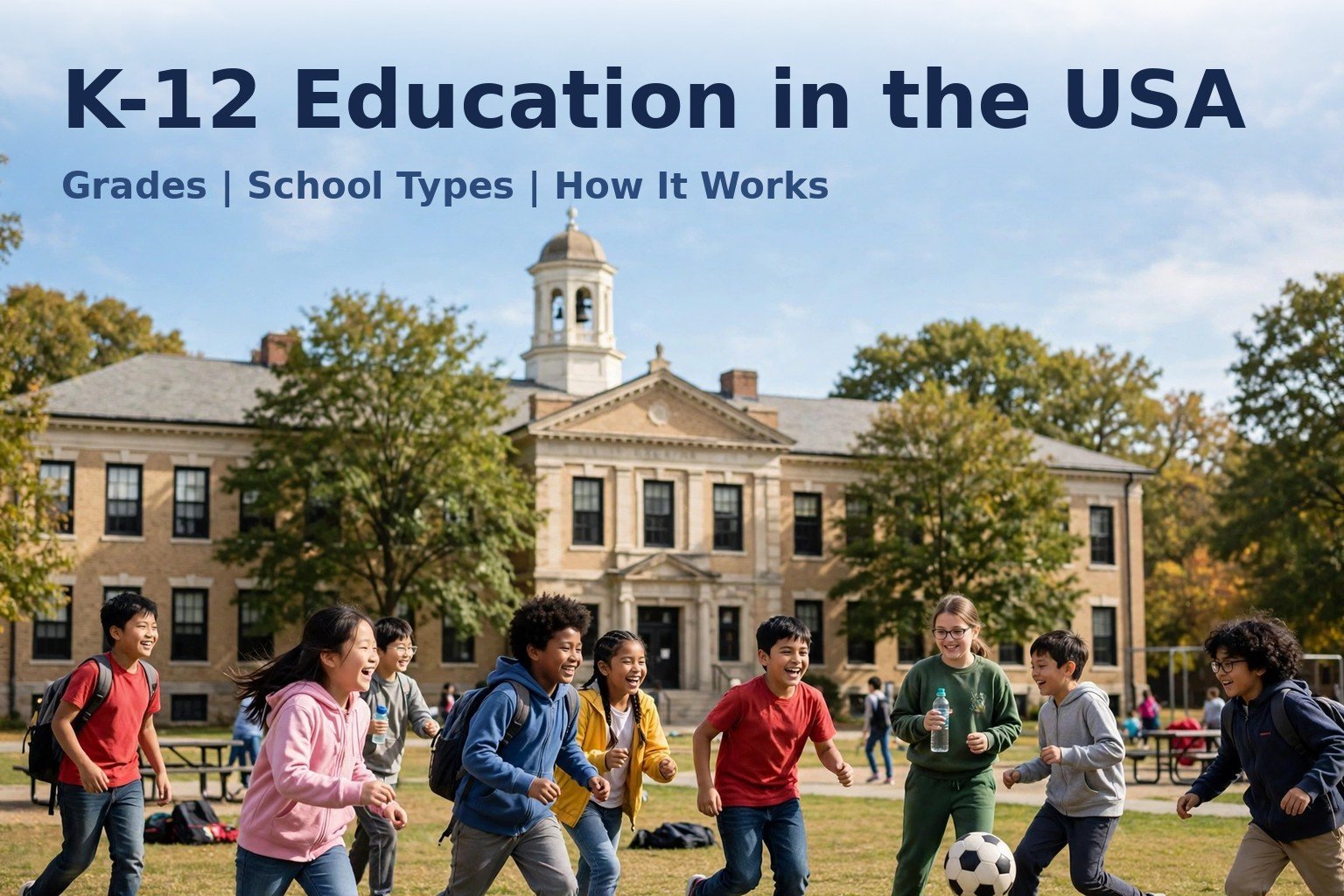
K–12 education in the United States covers the school years from kindergarten through grade 12. It is one of the most important parts of the U.S. education system, but it does not operate as one identical national school system. States, school districts, schools, and families can have different responsibilities and options.
This guide explains how K–12 education generally works in the USA, what the main school types are, how grade levels are organized, and where parents and students can find reliable information. For a broader overview of the full U.S. education system, see Education in the USA: Complete Guide to the U.S. Education System.
What Does K–12 Mean?
K–12 is shorthand for kindergarten through grade 12. In common U.S. usage, it describes elementary and secondary education before college or other postsecondary study. The exact organization of grades can vary by school or district, so labels such as elementary, middle, junior high, and high school are not identical everywhere.
NCES education statistics commonly separate public school enrollment into prekindergarten through grade 8 and grades 9 through 12. In fall 2024, public elementary and secondary schools enrolled about 49.9 million students across the United States. cite
How Are K–12 Grades Organized?
A typical pathway looks like this:
- Kindergarten: the first formal school year for many children.
- Elementary school: commonly includes kindergarten and several early grades, often through grade 5 or 6.
- Middle school or junior high: commonly serves grades 6–8 or a similar range.
- High school: generally covers grades 9–12.
These labels are useful for understanding the general structure, but they should not be treated as a universal national rule. NCES definitions show that school grade configurations can differ, and state and local systems determine many details.
Who Runs K–12 Education in the United States?
One of the most important things to understand about U.S. K–12 education is that the federal government does not simply run all public schools. States and local education agencies have major responsibilities for operating schools, setting policies, and implementing education programs.
The U.S. Department of Education provides federal programs, information, oversight, and resources. Federal K–12 law includes the Every Student Succeeds Act (ESSA), which is the federal K–12 education law and requires states to measure performance and provide public information through state report cards.
For families, this means that important details—such as enrollment rules, graduation requirements, curriculum standards, testing schedules, attendance rules, and school choice policies—can differ from one state or district to another.
Main Types of K–12 Schools
1. Traditional Public Schools
Traditional public schools are publicly funded and operated through public education agencies. Students often attend a school based on where they live, although assignment and choice policies vary by district and state.
NCES describes a public school as an institution that provides educational services, receives public funds as its primary support, and is operated by an education agency. cite
2. Public Charter Schools
Charter schools are public schools, but they operate under a charter that can provide more flexibility from certain state or local rules. In exchange, the school must meet the accountability requirements established in its charter.
According to NCES, approximately 7,800 public charter schools operated in the United States in 2021–22, representing about 8 percent of public schools at that time. These figures are historical NCES data rather than a current 2026 count.
3. Private Schools
Private schools are outside the public school system and are generally not supported primarily by public funds. They can include religious and nonsectarian schools and can offer different educational approaches or programs.
Rules for private schools vary by state. The U.S. Department of Education explains that regulation of private and home schools is primarily a state and local responsibility, and it maintains a state-by-state resource covering requirements such as registration, licensing, and accreditation.
4. Homeschooling
Homeschooling means that a child is educated at home rather than attending a traditional public or private school. Requirements can differ substantially by state, so families should check their state education department or the U.S. Department of Education’s state regulation resources before making plans.
The Department of Education states that it does not generally have jurisdiction over home schools and that regulation is primarily handled by state and local governments. cite
What Do Students Learn in K–12?
K–12 programs normally build from foundational skills toward more specialized academic and career preparation. Common areas include:
- English language arts and reading
- Mathematics
- Science
- Social studies and history
- Physical education and health
- Arts and music
- World languages, where offered
- Career and technical education in some schools and programs
- Technology and computer-related learning, depending on the school
There is no single national curriculum used by every U.S. K–12 school. States and local education agencies play important roles in standards, curriculum, instruction, and assessment.
How Are K–12 Students Assessed?
Students may encounter classroom tests, projects, school assessments, district assessments, and state-level standardized assessments. The specific tests and schedules depend on the state and grade level.
Under ESSA, states must measure performance in reading, mathematics, and science and provide information through state report cards. The U.S. Department of Education also provides access to the National Assessment of Educational Progress (NAEP), often called the Nation’s Report Card, which provides national and state-level information on student achievement.
How Does School Enrollment Work?
Enrollment procedures vary by state, district, and school type. A family may need to provide proof of residence, age documentation, immunization or health records where required, and other documents established by the relevant school or district.
For public schools, the assigned school may depend on the family’s address, but some districts offer additional choice options. The U.S. Department of Education’s education-choice resources cover public charter schools, magnet schools, private schools, homeschooling, and other options. cite
Because requirements vary, parents should use their state education department and local school district as the primary sources for current enrollment rules.
What Should Parents Compare When Choosing a K–12 School?
There is no single school type that fits every student. A practical comparison can include:
- Location and transportation: How far is the school and how will the student travel?
- Grade configuration: Which grades does the school serve?
- Academic programs: What courses, advanced programs, languages, arts, or career programs are available?
- Student support: What services are available for students who need additional academic or accessibility support?
- School performance information: What does the state’s report card show?
- School environment: What information is available about attendance, discipline, safety, and school climate?
- Costs: Public schools and private schools have different cost structures, and private-school expenses can vary significantly.
- Admissions or enrollment requirements: Are there boundaries, applications, lotteries, deadlines, or other requirements?
Why State-by-State Research Matters
Searching for “K–12 education in the USA” can make the system sound more uniform than it really is. In practice, a family’s experience can change significantly based on the state and school district.
For example, private-school and homeschool regulations are state-specific, and the Department of Education provides separate state information for those requirements. Public school policies can also vary because states and local education agencies have different rules and programs.
For this reason, a useful K–12 research process is:
- Identify the state where the student will attend school.
- Find the state department of education.
- Identify the local school district or school-authority website.
- Review enrollment, attendance, assessment, and graduation information.
- Compare eligible school options using official information.
Official K–12 Resources
For current information, start with authoritative sources rather than relying only on general school directories or social media.
- U.S. Department of Education: Elementary and Secondary Education
- U.S. Department of Education: Education Choice
- U.S. Department of Education: State Regulation of Private and Home Schools
- National Center for Education Statistics (NCES)
- NCES Elementary and Secondary Information System
Frequently Asked Questions
What does K–12 mean in the USA?
K–12 refers to kindergarten through grade 12, covering the primary and secondary school years before college or other postsecondary education.
Is K–12 education the same in every U.S. state?
No. States and local education agencies have significant responsibilities, so school structures, requirements, assessments, and policies can differ.
Are charter schools public schools?
Yes. Public charter schools are publicly funded schools that operate under a charter and have specific accountability requirements. cite
Does the federal government run local public schools?
The federal government supports and oversees federal education programs and laws, but states and local education agencies have major responsibilities for K–12 education.
Are private-school and homeschool rules the same nationwide?
No. Requirements are primarily determined by state and local governments, so families should check current rules for their state.
Where can parents find official school information?
Useful starting points include the state department of education, local school district, U.S. Department of Education, and NCES resources.
Key Takeaways
- K–12 means kindergarten through grade 12.
- The U.S. does not operate K–12 education as one identical national school system.
- Traditional public, public charter, private, and homeschool options have different structures and rules.
- State and local authorities are important sources for current enrollment and education requirements.
- ESSA provides a federal framework for accountability, assessment, and public reporting.
- Families should verify state-specific information before making enrollment or school-choice decisions.
Last reviewed: September 2026. Education policies, enrollment requirements, and state rules can change, so readers should confirm current details with official state and local sources.


2 thoughts on “K–12 Education in the USA: Grades, School Types, and How the System Works”